
Hotelier's Digest #11: The Real Story Behind HITEC 2026
HITEC 2026: Where the Tools Earn Their Place — and Where They Don't
This was a busy week for hotel technology. HITEC 2026 in San Antonio brought a wave of product launches, AI announcements, and new partnerships, but the more interesting story was how vendors are trying to reduce operational friction for hotel teams.
This week's edition looks at Oracle's expansion of AI within OPERA Cloud, Canary's automated group sales coordination, Tipmo's approach to cashless tipping, and a new loyalty partnership between Cloudbeds and Journey. The common thread is not artificial intelligence itself. It is the effort to remove administrative work from teams that are already stretched.
The key question for operators is not which tools have AI attached to them. It is which tools solve real problems, fit existing workflows, and earn a place in the operation.
HITEC Was a Useful Signal, Not Just a Trade Show
HITEC 2026 ran June 15–18 in San Antonio. The event brought hotel owners, operators, technology leaders, and vendors together around property systems, payments, cybersecurity, data, guest experience, and AI.
The pattern across the week was clear: hospitality technology vendors are moving beyond dashboards and workflow tools toward systems that make recommendations, write content, respond to guests, qualify leads, and coordinate work across departments.
That shift creates opportunity, but it also changes the operator's job. The question is no longer only "Which system should we buy?" It is also "Which decisions are we comfortable allowing software to shape, and how will we supervise those decisions?"
At HITEC, that question showed up in several ways:
- Oracle announced AI capabilities inside OPERA Cloud workflows.
- Canary launched an agentic sales coordinator for hotel group and event sales.
- Tipmo by GratifID showed a cashless tipping model designed for hotel, resort, restaurant, spa, and golf environments.
- Cloudbeds and Journey announced a partnership aimed at giving independent hotels more loyalty infrastructure without joining a traditional flag.
- The E20X pitch competition highlighted startups working on AI-native property management, guest data, email handling, operational intelligence, group booking automation, and smart-device deployment.
The common thread is not AI by itself. It is the attempt to remove administrative drag from hotel teams that are already stretched.
Want to learn more about the event? Here is a helpful HITEC 2026 event overview. Next HITEC events are in Paris (November 2026) and Tokyo (December 2026), while next year's USA event is in Orlando (June 2027).
Oracle Brings AI Further Into OPERA Cloud
Oracle announced Oracle OPERA Cloud Assistant, a set of AI-powered capabilities embedded inside OPERA Cloud workflows. The launch focuses on practical hotel work: operational knowledge access, intelligent room assignment, AI-generated rate descriptions, and multilingual operational content.
 LODGING Staff
For hotels already using OPERA Cloud, this matters because the AI is not being presented as a separate tool. It is being added to the systems where front desk, revenue, and operations teams already work. Hotel teams do not need another disconnected interface. They need fewer places to look, faster answers to routine questions, and better consistency across shifts and properties.
The more interesting part is the operational knowledge layer. If staff can ask natural-language questions about procedures, hotel documentation, and system workflows, AI can reduce manager dependency during peak periods. But the quality of the answers will depend on the quality of the underlying procedures. AI does not fix unclear SOPs. It exposes them faster.
Oracle's broader Digital Assistant positioning supports that direction. The platform is built to create conversational experiences through text, chat, and voice interfaces, with prebuilt skills, templates, and integrations.
What to do this week: If you're already on OPERA Cloud, ask your account rep when Assistant features roll into your contract tier, and which ones — room assignment, rate descriptions, knowledge access — ship first. Don't wait for a renewal cycle to find out.


Tipmo Makes Cashless Tipping Operational
One of the more practical announcements from HITEC came from Tipmo by GratifID, a cashless tipping platform designed for hotels, resorts, restaurants, spas, and golf facilities.
The challenge it addresses is straightforward: many guests no longer carry cash, but tipping remains an important part of how service employees are recognized and rewarded. Housekeepers, bell staff, valet attendants, spa therapists, and other guest-facing employees can miss out simply because the payment habits of travelers have changed.
Tipmo uses NFC-enabled tags that guests can tap with their phone to leave a tip using Apple Pay or Google Pay, without downloading an app or creating an account. For management, the platform provides reporting on tip activity and guest feedback across departments.
The technology itself is not the story. The more interesting question is whether hotels are adapting traditional service models to match modern guest behaviour. As fewer guests carry cash, properties need practical ways to ensure staff still have access to gratuities and recognition.
For hotels considering a platform like this, the discussion should go beyond technology. How will the data be used? Will tipping information support staff recognition, or become another performance metric? Clear communication with employees is just as important as the software itself.
Canary Targets the Lost Time in Group and Event Sales
Canary Technologies announced its Agentic Sales Coordinator for Hotel Group and Event Sales.

The product is designed to capture, qualify, and move group and event sales inquiries from first contact toward confirmed booking. Canary describes the problem plainly: hotel sales teams receive too many unvetted opportunities, spend too much time qualifying them, and can miss leads because administrative work slows the response.
This is a real pressure point for independent and smaller hotel groups. Group and event demand can be valuable, but it is messy. Inquiries are often incomplete, lead quality varies, response time matters, and sales managers can lose hours sorting through requests that may never convert. A sales coordinator fielding dozens of inbound inquiries a week doesn't lose revenue because the leads are bad — the good leads sit in the same queue as the bad ones until someone has time to sort them.
If tools like this work as promised, the value is not only automation. It is prioritization. A hotel that responds faster and qualifies better can focus human sales time on the opportunities most likely to close.
Before adopting a tool like this, operators should check:
- Does it integrate cleanly with the property's existing sales, catering, PMS, and CRM workflows?
- Can the hotel define what a good lead actually means in concrete terms — budget range, date flexibility, group size — rather than leaving qualification vague?
- Does the AI support the sales process without making that first interaction feel generic?
- Is there a clear trigger point for handing the lead off to a human sales manager, rather than a guess?
Cloudbeds and Journey Aim Loyalty at Independents
Cloudbeds and Journey announced a partnership giving Cloudbeds Collection properties access to a shared loyalty ecosystem — aimed at helping independent hotels compete with chain and OTA loyalty programs without losing their identity.


The pitch: pooled guest relationships let smaller properties offer redemption options they couldn't fund alone. Take a 35-room boutique hotel with roughly 200 repeat guests a year, mostly regional travelers who book direct two or three times annually. On its own, that property can't generate enough transaction volume to make a points program worth a guest's attention. Folded into a shared ecosystem with dozens of other independents, those same 200 guests gain redemption options across markets they might actually visit. The risk: guests start to feel like they're collecting points in someone else's program if the brand voice disappears behind a shared interface.
Before signing, operators should ask:
- Who owns the guest data?
- How are rewards funded at scale?
- Which bookings qualify for incentives?
- Does this strengthen direct booking, or just add a discount?

If you’re considering Cloudbeds as a PMS and channel manager for a small independent hotel, I can help you think through whether it fits your property, workflows, and distribution strategy.
Contact Four Sides Hospitality Consulting to learn more.
The Turndown
For this week's media feature, The Turndown, Cloudbeds' podcast hosted by Sebastien Leitner, VP of Strategic Partnerships at Cloudbeds, offers a useful counterpoint to many of the conversations coming out of HITEC.
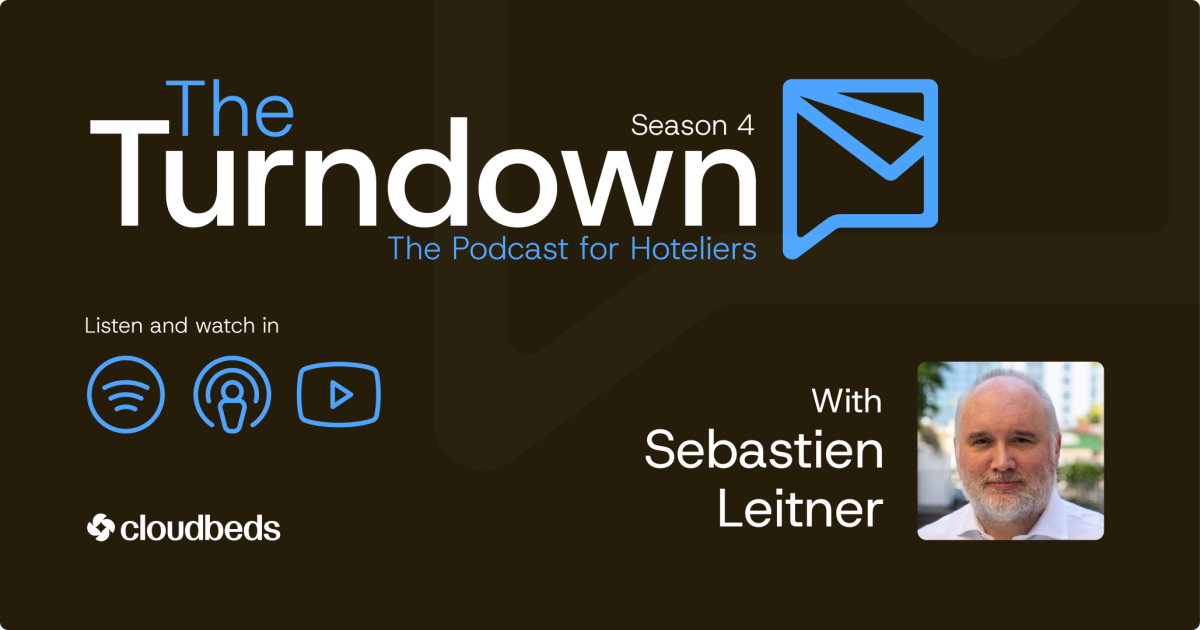
The latest episode features Marie Pier Germain, Co-President of Germain Hotels, discussing the growth of one of Canada's most distinctive independent hotel groups while maintaining the family values, design philosophy, and guest experience that shaped the brand from the beginning.
The conversation lands against the same backdrop as many of this week's technology announcements. Hotel technology is evolving quickly, but the advantage for independent and family-led hotel companies still comes from clarity of identity, disciplined growth, and a culture that guests can feel when they walk through the door.
Growth does not have to mean standardization. As brands expand, the challenge is ensuring that systems, processes, and technology support what makes the property unique rather than gradually replacing it.
After a week of AI announcements and automation tools, this episode serves as a useful reminder that technology can support a brand, but it cannot create one.
Stillness and Strategy
“And like any overworked manager, [the thinking mind] cannot remember a time when it was not on duty.”
Alex Olshonsky's recent essay, The Cure for Your Thinking Addiction, explores the idea that many of us have become attached to constant problem-solving. The mind is always searching for the next issue to address, the next decision to make, or the next threat to anticipate. In hospitality, where interruptions are constant and the work never truly feels finished, that habit can easily become the default operating mode.
The hospitality industry rewards quick decisions, but some of the most important ones—pricing, staffing, capital investments, and market positioning—benefit from slowing down long enough to understand the situation clearly.
As technology takes more routine work off our plates, the opportunity is not simply to do more. It is to create space for better judgment. The hotels that gain the most from automation may not be the ones moving fastest, but the ones using that time to think more deliberately about what matters next.
Closing Thought
Closing Thought
Every announcement in this week's issue is attempting to solve the same underlying challenge: not enough time, not enough people, and very little room for error when guests, staff, and revenue are all depending on the right decision.
That is worth remembering the next time a vendor pitch leads with "AI-powered" rather than the problem it is designed to solve. The technology itself is rarely the point. What matters is whether it reduces friction, improves decision-making, or creates capacity for the people running the hotel.
The properties that benefit most from this next generation of hospitality technology will not be the ones that adopt the most tools. They will be the ones that evaluate new systems carefully, keep what earns its place, and protect the identity, culture, and guest experience that no software can replicate.
Technology can reduce administrative work. It can surface information faster. It can help teams move more efficiently. But the work of hospitality still depends on judgment, relationships, and a clear understanding of what makes a property worth choosing in the first place.
Run the test. Keep what passes. Let the rest stay on the trade show floor.